Newer and faster is not always better. On an Adventure bike especially the long way round is almost always better. That is definitely the case here.
Not that I’m against development and the marvels of engineering but let’s start at the beginning.
Between the towns of Paarl and Worcester in the Western Cape of South Africa lies the formidable Du Toitskloof Mountains. A significant barrier between the Cape Winelands and the South African interior. An idea for a tunnel through the Du Toitskloof Mountains was conceived in the 1930s but was put on hold due to the outbreak of World War II. The idea developed into a pass over the mountains, the Du Toitskloof pass, using the labour of Italian prisoners of war between 1942 and 1945.
Plans for a tunnel was never abandoned though and Geological surveys and design started in 1973, and excavation followed in 1984, tunnelling from both ends using drilling and blasting. The two drilling heads met with an error of only 3 mm over its entire 3.9 km length. The tunnel was finally opened on 18 March 1988. The tunnel was named after the French Huguenot refugees that settled in the area in the late 1600s with one of the Huguenot refugees being Francois Du Toit, after whom Du Toitskloof was named.
This is what the tunnel looks like from the Northern entrance (Worcester side) travelling towards Paarl / Cape Town.
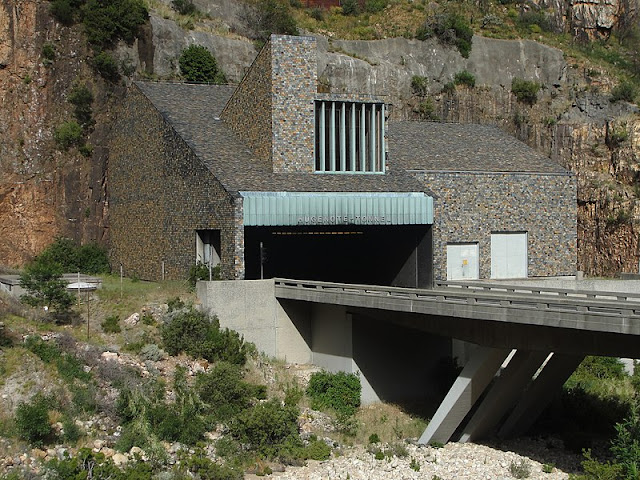
Photo by Zaian (sourced from Wikipedia)
Riding through a tunnel on a bike sounds like fun and I once rode a Harley Fatboy with Screaming Eagle pipes through the tunnel specifically to hear that glorious Harley sound. It was pure enjoyment… for about 30 seconds. Then the reality of so much traffic and exhaust fumes in a single lane tunnel hit. For the next almost 4 kilometers I was breathing dirty air while crawling along at 80km/h. On average 12,000 vehicles use the tunnel every day with up to 22,500 vehicles using it daily on holidays.
So during a recent ride from Cape Town to George, ‘n nice 450km ride, the tunnel was never an option. The alternative is the pass over the mountain. The tunnel diverts the bulk of the traffic away from the pass and on top of that they are busy with maintenance work, so I encountered very little traffic on the pass on the day.
This is the view of the bridge on the South side of the tunnel as you start ascending the pass:
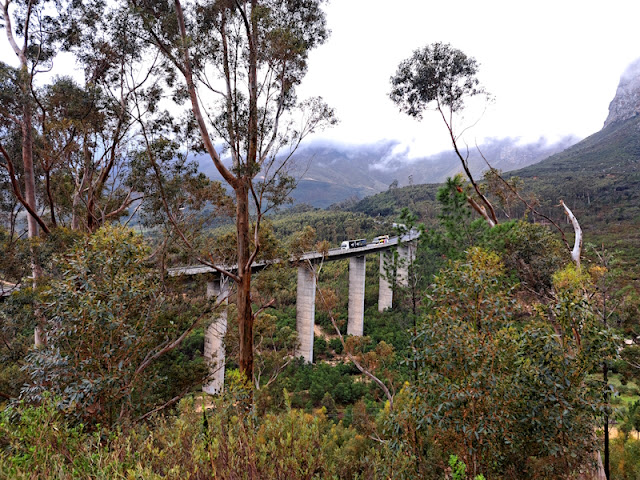
Vehicles are quite exposed on that bridge and it has happened several times that trucks, trailors and caravans have blown over in heavy wind. The tunnel gets closed in such conditions and then all traffic gets diverted over the pass.
Another view of the Southern exit of the tunnel from a little higher up:
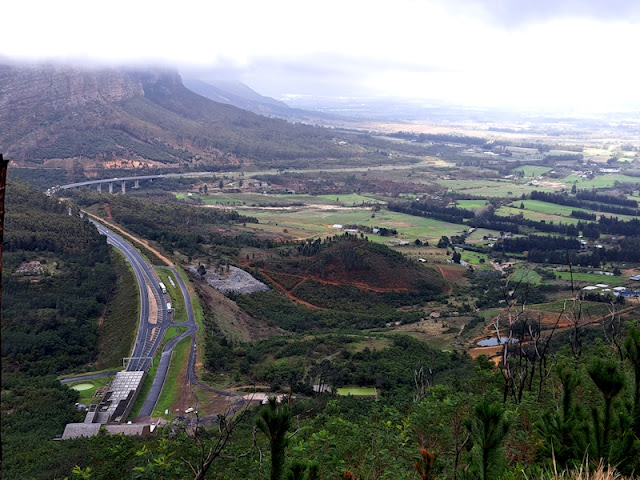
The tunnel exits below with the bridge now in the distance.
On a brilliant sunny day, you can see all the way to Paarl rock and even the Afrikaans Language Monument, but this was a slightly overcast day.
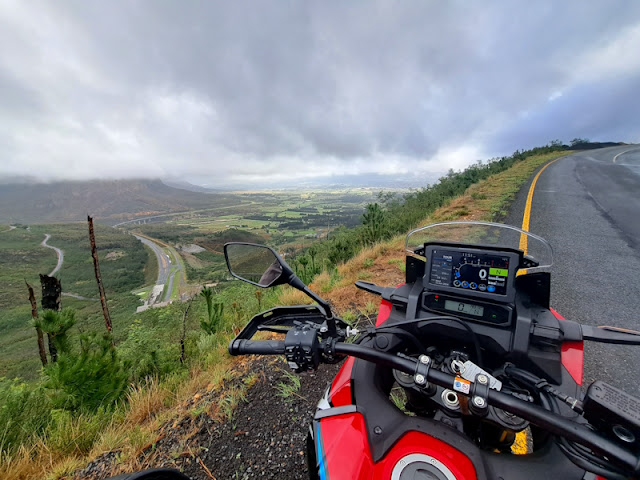
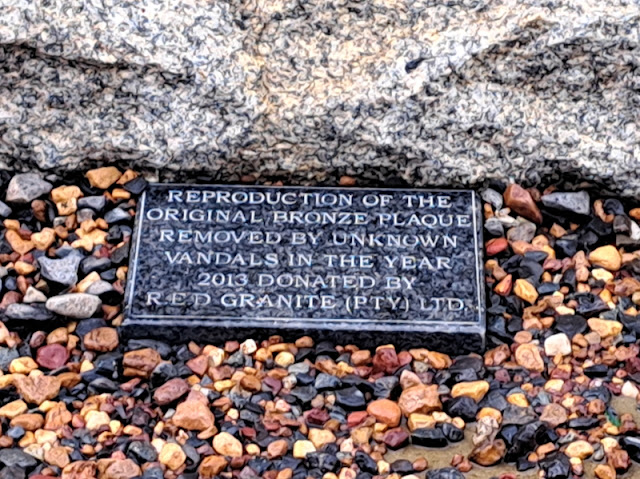
Halfway up the pass there is a plaque dedicated to the Italian POWs who helped build the pass.
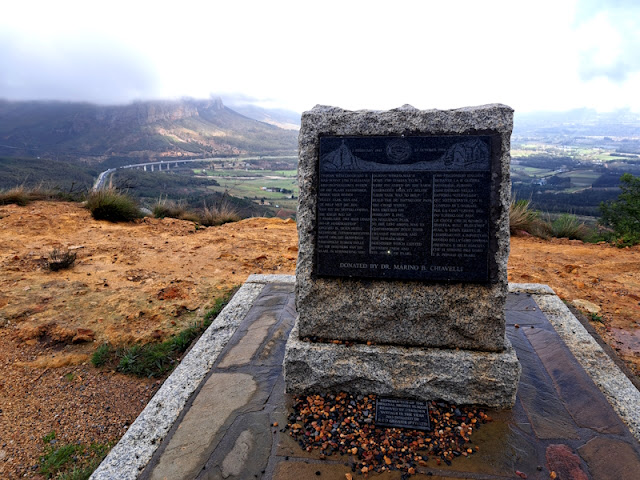
Ascending to the top of the pass I found myself in the clouds, the mountains and peaks around me totally obscured. The surrounding peaks often sport a covering of snow, and the Mountain Club of South Africa has huts in the area. Du Toits Peak is the highest mountain at 1,995 metres (6,545 ft). The vegetation is almost exclusively fynbos of the Cape floristic region we wrote about here. Suffice to say that if you ever have the opportunity, take the pass. The scenery is totally worth it!
The pass was named after Francois Du Toit, a 17th-century Huguenot refugee and pioneer who settled in the foothills. In 1930, engineer P.A. de Villiers (the Outeniqua Pass between the towns of Oudtshoorn and my hometown George was also receiving the same attention by the same engineer) explored the idea of a road over the pass and in 1938 it was investigated further by the National Roads Board with the route finalised in 1940. The project was started in the summer of 1941/42 and the 40 km long pass was opened in March 1949 by Prime Minister DF Malan.
The pass though has its own 200m tunnel dated 1948.

History, scenery and a much more leisurely ride. This will beat coughing through the tunnel every day of the week!
Article: Johann van Tonder