
The Ballot’s Bay Treasure
In 1788, a Prussian traveller's valuable treasure reportedly vanished beneath the waves at Ballot's Bay near George. Discover the legend of the lost chests, the daring treasure hunters who followed, and the remarkable natural beauty of this secluded Garden Route hideaway.
Treasure story: Hugo Leggatt
Imagine standing on the dunes above Wilderness in August 1788.
There were no houses, no roads and certainly no bridges across the Touw River. The coastline was wild, with dense forests, enormous stretches of unspoilt beach and perhaps even elephants and buffalo moving through the surrounding countryside.
Now imagine a strong south-easterly wind blowing across the bay.
Far out to sea, you notice something unusual. A small raft is being swept along the coast towards the rocky cliffs to the west. There appears to be a man aboard, perhaps more than one, and several heavy chests.
Eventually, the raft disappears into the surf below the cliffs.
What you have just witnessed, according to one of the Garden Route’s most intriguing old stories, is the beginning of the mystery of the Ballot’s Bay treasure.
A Prussian traveller and a ship called Maria
The story begins in Europe, where a Prussian field marshal by the name of von Möllendorff had a son called Joseph.
Joseph was an artist with an interest in the treasures of the East. According to the old account, relations between father and son were not particularly good, and Joseph eventually travelled to Asia, where he began collecting valuable works of art.
By December 1787, he was on his way home aboard the Dutch ship Maria, which had sailed from Ceylon, now Sri Lanka.
The voyage was a disaster.
By August 1788, the Maria had reached Plettenberg Bay in a dreadful condition. The crew had been severely weakened by scurvy, the disease caused by a lack of vitamin C, and the vessel was badly in need of attention.
The ship’s arrival and subsequent wreck at Plettenberg Bay are recorded in Dutch maritime history.
But what happened to Joseph and his possessions is where the story becomes particularly interesting.
The raft and the missing treasure
According to the tale, Joseph became convinced that the Maria was about to be wrecked near Robberg.
Fearing the loss of his precious collection, he persuaded members of the crew to build him a raft. His valuable chests were loaded aboard and he set off into the rough sea.
The wind and current reportedly carried the raft westwards along the coast.
Eventually, it approached the narrow opening of what we know today as Ballot’s Bay.
And then disaster struck.
A large wave overturned the raft, throwing Joseph and his belongings into the turbulent water.
Joseph survived, but his arm was badly broken. Some accounts claim that the injury was so severe that the arm later had to be amputated.
His precious chests were not so fortunate.
They sank among the rocks beneath the water. According to the story, at least one of the heavy chests could still be seen, wedged firmly between the submerged rocks, but nobody could get it out.
Joseph eventually moved to the Klein Karoo, where he married and made a new life.
His treasure, however, remained behind.
The treasure hunters return
Over the years, the tale of the lost chests attracted several attempts to recover them.
One of the most extraordinary was reportedly made in 1935 by a man named E. Lovemore.
His plan was certainly ambitious.
He stretched a cable across the bay and suspended a platform from it. A ladder descended from the platform into the water, while his diving equipment consisted of a weighted belt and a modified army-surplus gas mask.
Two assistants pumped air into the mask from above.
It sounds more like something from an adventure film than a sensible diving expedition.
Unfortunately, the search produced no treasure, and Lovemore reportedly came dangerously close to losing his life.
Whether the chests ever contained the fabulous riches described in the old story, and whether anything remains beneath the water today, is still part of the mystery.
But the legend has survived for more than two centuries.
And perhaps that is a treasure in itself.
Ballot’s Bay today: A different kind of treasure
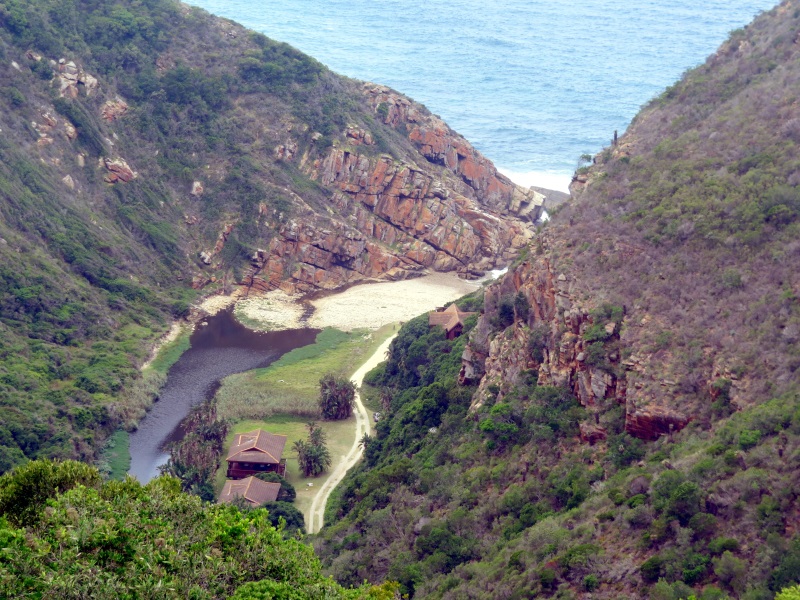
The first time you travel down towards Ballot’s Bay, it is difficult to believe that such a place exists barely 15 minutes from George.
The coastline here is rugged and spectacular. Steep hills covered in indigenous vegetation plunge towards the Indian Ocean, and a small, secluded beach lies tucked between enormous rocky cliffs.
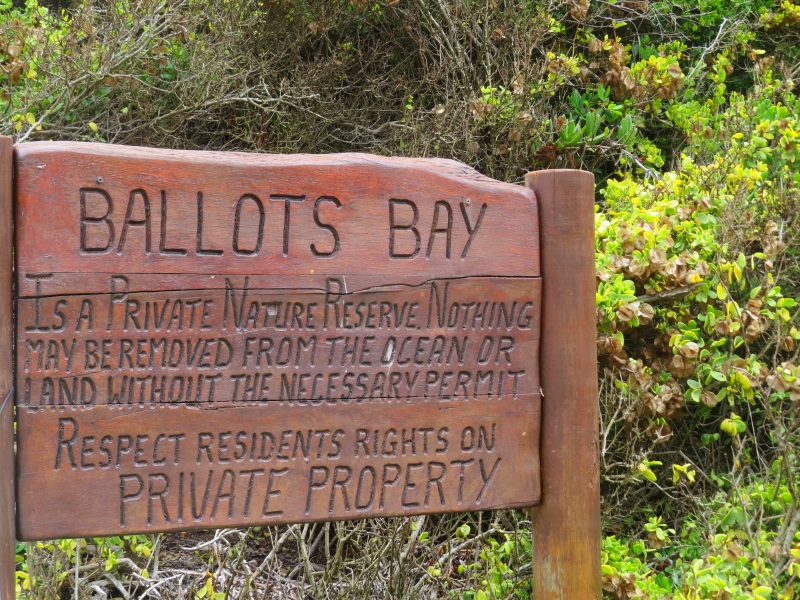
The bay forms part of a private nature reserve, where the natural environment has been carefully protected and rehabilitated.
Bushbuck, grey duiker, bushpigs and caracals are among the animals associated with the surrounding habitat, while the forests and coastal vegetation provide a home for a remarkable variety of birds.
It is the sort of place where the outside world seems very far away, even though the busy Garden Route is just over the hills.
The minister who dreamed of a harbour
Ballot’s Bay was originally known as Christina Bay.
It was later named after the Reverend J.S.S. Ballot, one of George’s most influential early ministers.
But Ballot was interested in much more than church affairs.
He dreamed of developing the secluded bay into a fishing harbour for George, with a small community that could make a living from the sea.
He even had plans for a settlement called Ballotsdale.
The difficult coastline, unpredictable sea conditions and practical challenges of establishing a fishing industry eventually put an end to the dream.
Yet the old minister left his name on the landscape.
He was also associated with an early route down towards the bay, although this was not the same road visitors use today.
That distinction is important, because the present Ballot’s Bay Pass has its own fascinating story.
A remarkable road through the forest
The narrow private access road that twists down through the hills was built by Christo Cloete and completed in 1993.
It was no ordinary road-building project.
Cloete had to find a route through steep valleys, dense indigenous vegetation and difficult river crossings. In places, he had to crawl through thick undergrowth simply to work out where a road might be possible.
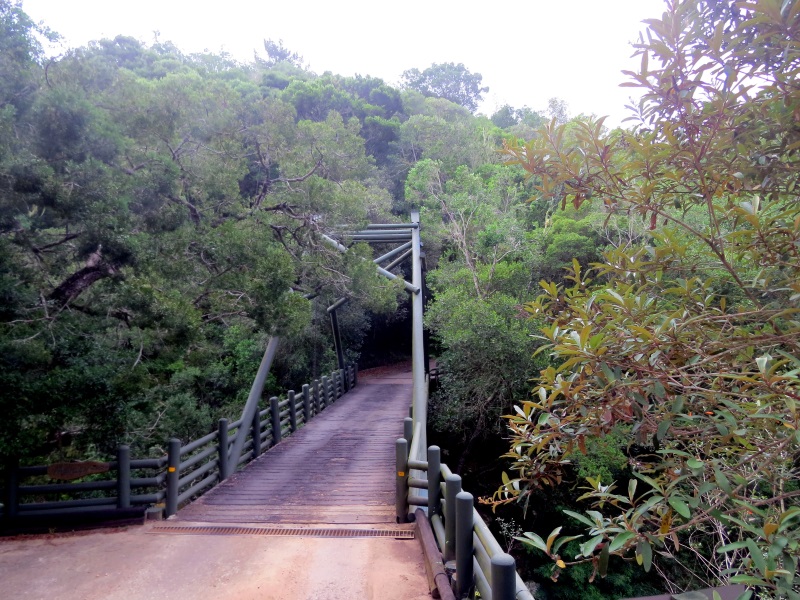
The project required two bridges, including a timber suspension bridge across the Meulen River.
The result is a remarkable little mountain pass, with steep gradients, tight bends and stretches where the surrounding vegetation forms an almost complete canopy overhead.
It is a beautiful drive, but it is also a private road. Access is restricted to residents, guests and authorised visitors.
Cloete also played an important role in restoring the natural environment. Large areas that had been affected by invasive vegetation and earlier land use were rehabilitated, with indigenous plants reintroduced.
He and his father, Jan, later helped build a small stone chapel overlooking the ocean, completing it in 1994.
It is another unexpected chapter in the story of this extraordinary little corner of the Garden Route.
Perhaps the real treasure was never lost
It is tempting to imagine that somewhere beneath the waves, among the rocks at the entrance to the bay, a centuries-old chest still contains the remains of Joseph von Möllendorff’s collection.
Perhaps it does.
Perhaps it never did.
But standing above the little beach, looking out across the Indian Ocean and listening to the waves crashing against the cliffs, it becomes difficult to imagine a more valuable treasure than the place itself.
The forests, the winding mountain pass, the little river and the unspoilt coastline are all reminders of the natural beauty that once characterised so much of the Garden Route.
And the fact that such a place can still exist, so close to a growing town, is something rather special.
Some treasures are buried beneath the sea.
Others are right there in front of us.
We just need to recognise them.