In Search of the Karoo Mermaid
Why do people tell stories of a Watermeid in one of South Africa’s driest regions? A search on a motorcycle took me to the deep pools, remarkable people and old tales of the Klein Karoo.
The Watermeid crossed my path long before I ever went looking for her.
It was my wedding day in November 1996 when the rain began. And once it started, it seemed in no hurry to stop. In the days that followed, the Olifants River came down in flood, Oudtshoorn and the surrounding district were inundated, and large sections of the road through Meiringspoort were washed away. Even some of our wedding guests had to take enormous detours to get home.
While people were still trying to take stock of the damage, a rather different story began doing the rounds. The Watermeid, who was said to live in the deep pool beneath the Meiringspoort waterfall, had apparently been swept away in the flood. According to the tale, she travelled all the way down to the sea, was fished out near Mossel Bay and ended up at the CP Nel Museum in Oudtshoorn.
A mermaid in the Karoo? Surely that was a story worth investigating.
What began to bother me later, however, wasn’t whether someone had actually hauled a fish-tailed woman out of the ocean. It was a much more interesting question: why were there so many stories about a mysterious woman living in the water in one of the driest parts of South Africa?
I decided to follow the trail. The motorcycle would get me to the places. For the answers, I would have to talk to the people.
The Watermeid in the clock tower
As I remember it, somebody joked on the radio during the floods that the Watermeid must have been washed out to sea. Then came reports on Suid-Kaap Stereo that she had been found and taken to the CP Nel Museum. The story reached RSG as well, and that was when things really got out of hand.
The museum’s telephone started ringing. People wanted to know where the Watermeid was, when they could see her and whether the museum was really keeping her in a tank. Visitors travelled from far and wide. Some were apparently less than impressed when there was nothing to show them.
So the museum staff made a plan. A shop mannequin fitted with a homemade fish tail was put on display in the clock tower. Instead of bringing the story to an end, it gave it new life. A newspaper report published a few years later claimed that more than 2,000 people came to see the Watermeid. Even the police became involved in the final chapter of the affair.
Somewhere amid the excitement, the Watermeid acquired a name: Eporia. And she didn’t remain merely a museum curiosity. She went on to find a place in art, on stage and in stories of her own.
Years later, my son and I knocked on the museum’s door. Naturally, we wanted to see the famous Watermeid. She was no longer in the tower, but the staff kindly fetched her from storage for us.
And there she was. The Watermeid of the Klein Karoo. A mannequin with a fish tail.
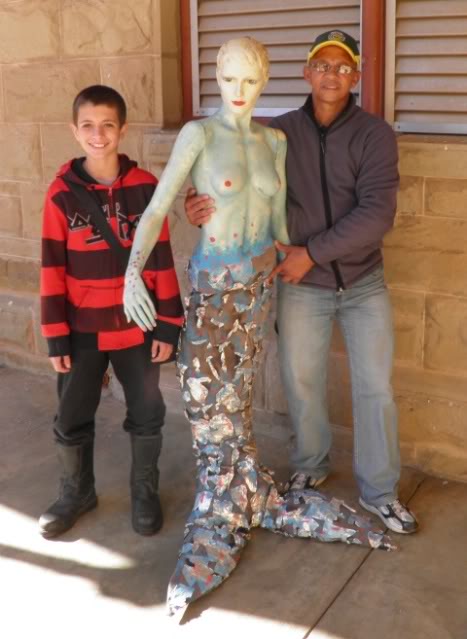
We had therefore managed to see a Watermeid before the search had properly begun. It was an encouraging start, but I suspected the most interesting part of the story lay beyond the museum walls.
Rooiwalle and a little bait
One of the tales that circulated after the floods led me to Rooiwalle. There were stories of another encounter with the Watermeid after, according to the museum tale, she had returned to the river. With its red rock faces and stretches of water, the place has a character all its own. It wasn’t difficult to see how a story could become attached to a landscape like this.
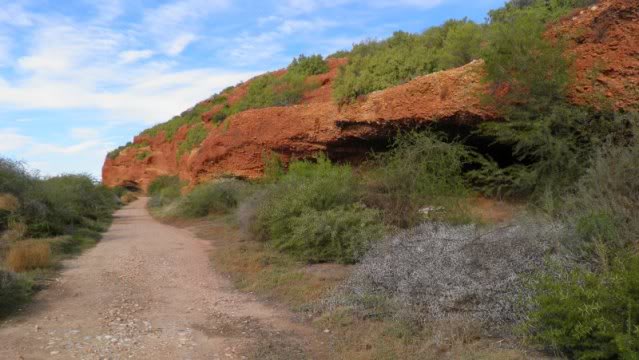
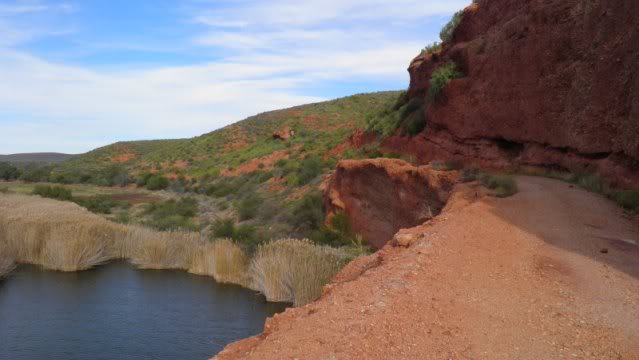
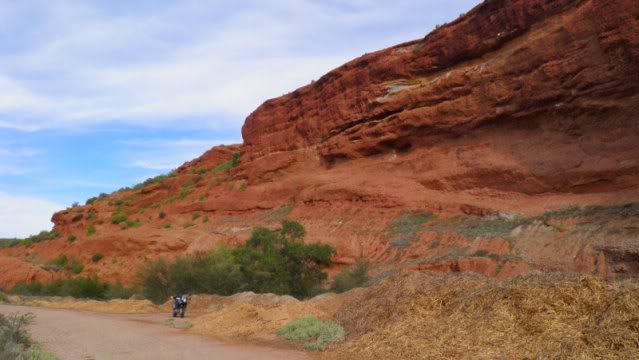
At Eseljagtspoort, the search became a little more purposeful. I took my youngest son along. According to one of the old stories, children were particularly at risk near the Watermeid’s pools. I therefore reasoned, rather dryly, that if you’re hoping to catch something, a little bait might be useful.
He survived the joke. We caught nothing.
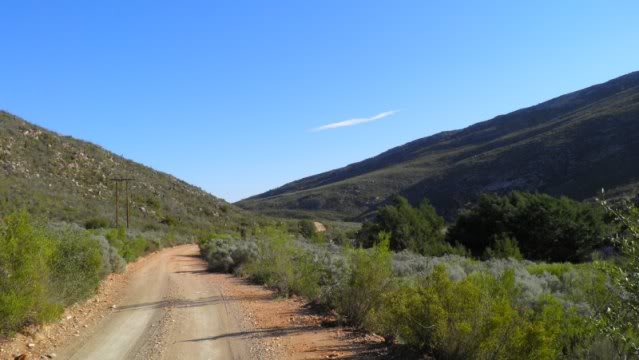
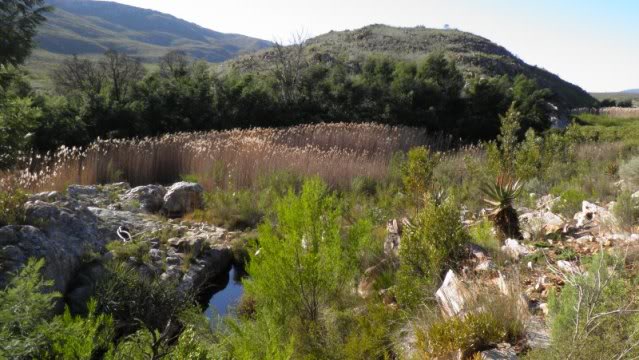
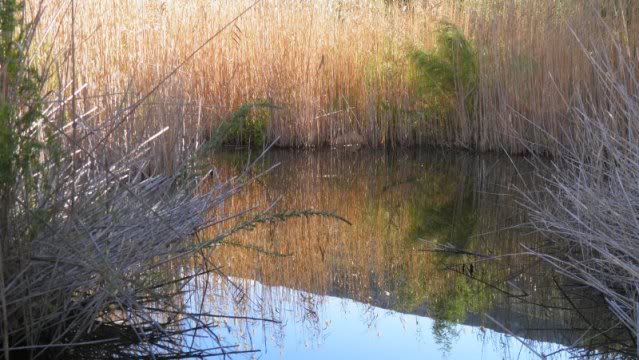
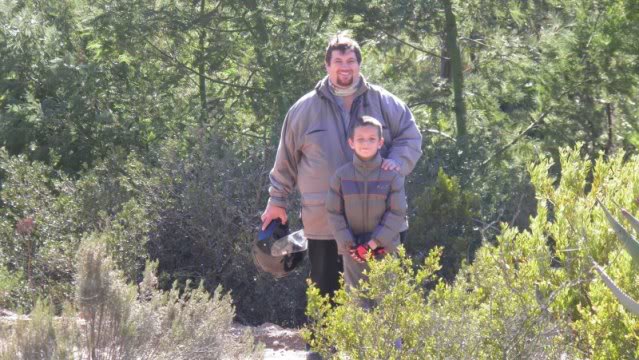
What we did find was exactly the sort of place described in the stories: pools tucked between rocks, dark water in the deeper stretches and thick reeds along the banks. There had been good rain recently, and the Klein Karoo was unexpectedly green. Even the water crossings on the gravel roads added a little entertainment to the ride.
I began to notice a pattern. The Watermeid’s name kept cropping up where water was deep, where reeds grew thick or where a river squeezed through a narrow gorge. These weren’t necessarily the grandest or most beautiful places. Often they were places where you couldn’t quite tell what might be hiding beneath the surface.
Eseljagtspoort, as it turned out, also had a Watermeid story far older than the one involving the museum. I would come across that particular trail again later in my research.
The man at the garden gate
We rode across the Klein Karoo towards Dysselsdorp. There I noticed a man standing at his garden gate, watching the world go by. I stopped for a chat.
His name was Samuel Levin.
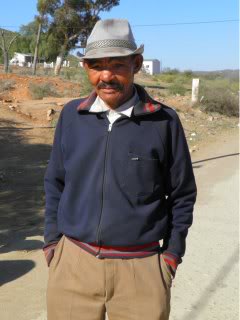
Samuel had grown up in Dysselsdorp, although he had not been born there. He knew the Watermeid stories well. But for him they were more than tales from a book. He told me that his brother-in-law had drowned in the Olifants River. According to Samuel, the man was able to swim, but disappeared beneath the water and his body had to be recovered by divers.
Samuel believed that the Watermeid had been responsible. The conversation brought home how closely these stories could be woven into people’s real grief. He was also worried about his grandchildren playing near the river, and directed us towards the area where the waterhole lay.
The pool was on private land, so rather than simply riding in, we stopped at the farmhouse to ask permission. The farmer’s wife knew the stories too, and took us to a deep pool from which water was pumped for irrigation. She told us that nobody really knew how deep it was and that somebody had drowned there years before.
The water was dark and deep enough to make you understand how a place like that develops a reputation. Once again there were reeds.
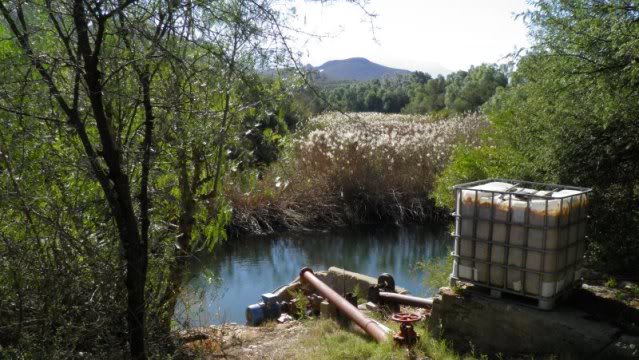
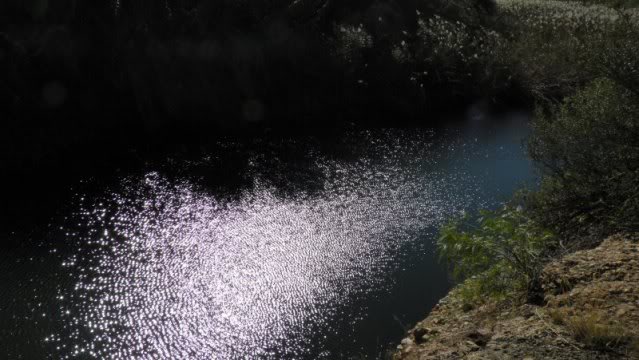
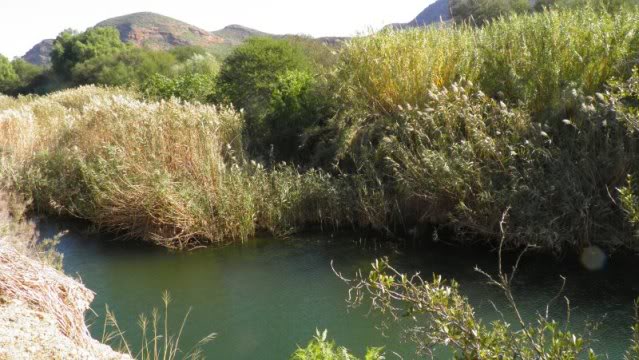
On the ride back I realised that the investigation was beginning to change. I still hadn’t seen a Watermeid, but I had met people for whom the stories were deeply personal. The question was no longer simply where the Watermeid lived. It was also why so many people associated her with the same kinds of places.
The pool in Meiringspoort
You cannot follow this trail without riding through Meiringspoort.
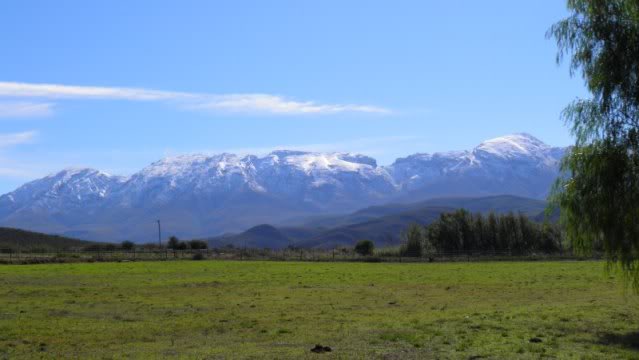
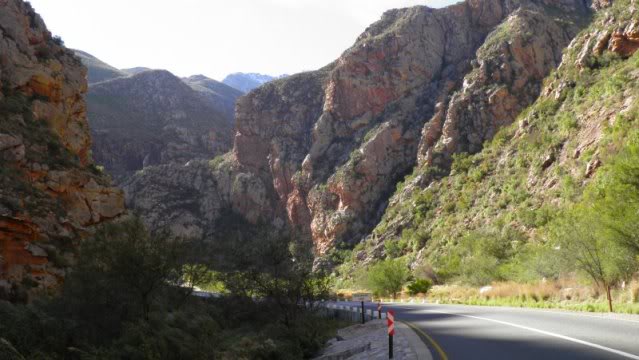
There was snow on the Swartberg, and the road through the poort was every bit as beautiful as I remembered it: towering rock walls above the tar, tight bends and a river winding its way through the gorge. On a quiet day it seems almost impossible that the same river could tear up the road so violently when it comes down in flood.
It was here that I thought again about a wonderful story I had come across during my research: Antoinette Pienaar’s “Hoe Meiringspoort gemaak is” (How Meiringspoort Was Made).
Antoinette, the well-known Karoo storyteller, actress and singer who has also been a familiar voice on RSG, gave Eporia an entire world of her own. In her telling, the Watermeid lives in a pool in the Klein Karoo. The animals crown her their queen, and she befriends Absolom, a shepherd. Gamka, the last Cape lion, rules the animal kingdom with quiet authority.
Then hunters arrive and destroy the peace. Even Gamka is killed. Eporia’s sorrow turns to fury, and she calls the waters together. A great flood tears through the mountains, splits the earth and carves out the poort.
What a marvellous image. History can tell us how the road through Meiringspoort was built. Antoinette’s story tells us how the gorge itself came into being, at least in Eporia’s world. I also discovered that she had brought the character to the stage in a production called Eporia. In that way, a local Watermeid gained a life far beyond her original pool.
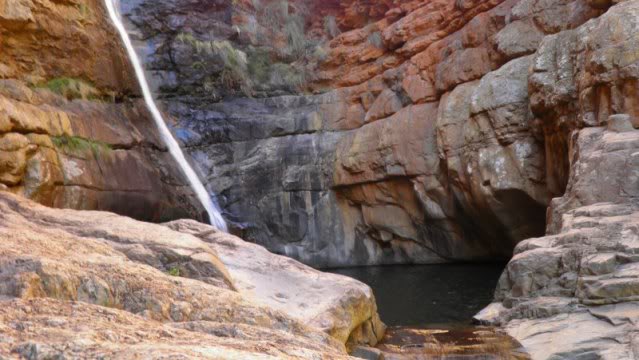
At the famous waterfall I followed the path up to the deep pool. The waterfall is about 60 m high, and the pool beneath it is said to be roughly 9 m deep, although the old claim that it is bottomless has been around for years. The walkway to the falls was prepared in 1925 for a visit by the Prince of Wales.
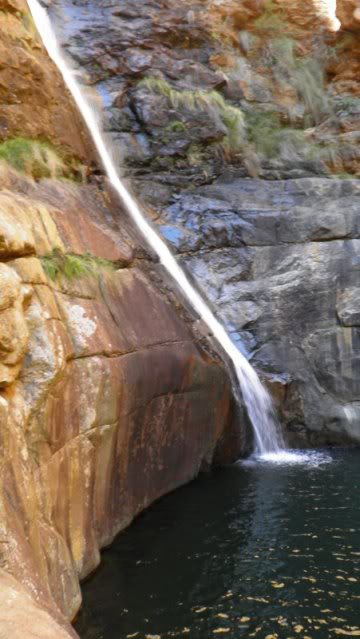
There, between the water-smoothed rocks, the pool seemed darker than the clear stream tumbling over the stones farther down. It had an atmosphere of its own. If I were a Watermeid, I could quite understand why this would be one of the more desirable addresses.
At the rest stop I spoke to Katrina Koorts. She knew the history of the poort and was thoroughly familiar with the Watermeid tale. But when I asked whether she believed in it, her answer was a simple no. Why not? Because mermaids didn’t exist, she reckoned.
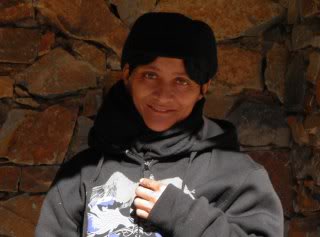
I had to smile. Here was someone working beside one of the Karoo’s most famous Watermeid pools, and as far as she was concerned the matter had long since been settled.
Farther along the road I was to get a very different answer.
Jan Arries’s warning
At Boesmansdrif I met Jan Arries from De Rust. He was collecting wood when I stopped to talk. Jan knew all about the Watermeid, although he said he had never actually seen her. Nor was he particularly keen to meet her.
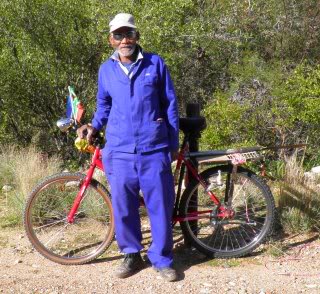
He told me about two friends who, he said, had drowned: one at Meiringspoort and the other at Stompdrift Dam. Both could swim, he told me, and in both cases divers had been called in to recover their bodies. Jan believed the Watermeid had been involved.
I later went to Stompdrift to have a look for myself. A dam might seem a very different sort of place from a natural pool hidden among the mountains, but here were the same elements: deep water, a story of loss and someone who associated the Watermeid with it.
What struck me was how differently people spoke about her. To Katrina she was simply a story. For Samuel and Jan, she was bound up with people they had known. Yet I was still looking for someone who could say that he had seen the Watermeid with his own eyes.
Mermaids on the rock walls?
Then the search took a turn I had not expected at all: rock art.
In the Klein Karoo there are San paintings of unusual figures that, to a modern eye, can look almost like human beings with fish-like lower bodies. Some have arms, others appear to have wings, and the whole scene is much stranger than the familiar picture-book mermaid.
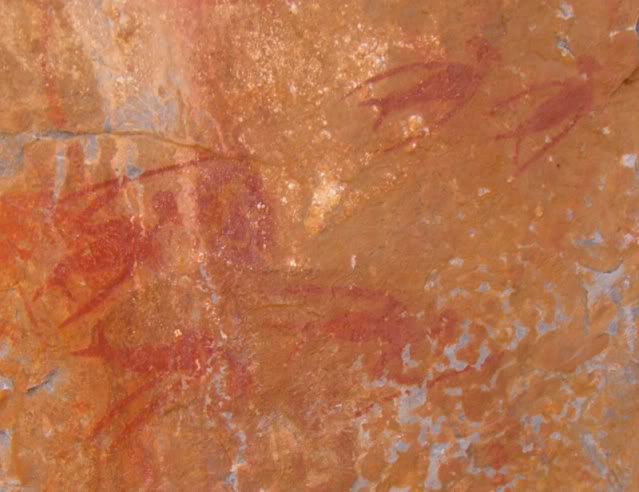
The famous Ezeljagdspoort painting, showing human-like figures with forked tails, can also be viewed on Bruce Rimell’s website.
In Prince Albert I spoke to Judy Maguire and John Begg, who knew the region’s geology, fossils and heritage well. They thought some of the figures looked more like swallows or swifts, birds people have long associated with rain. Looking at certain paintings, it wasn’t a difficult interpretation to understand.
But other figures kept me wondering. One appeared to be holding something, almost like a flute. Eventually, with permission from the relevant landowners, I visited several rock-art sites. Seeing the paintings on the stone itself was far more moving than studying a reproduction in a book. There was the rock face, the old traces of pigment and the surrounding landscape in which people long before us had expressed something of their stories and spiritual world.
The Ezeljagdspoort paintings were copied as early as the 1830s. Since then, researchers have proposed different interpretations. Some place the figures within San ritual, trance and rainmaking traditions. Dr Renée Rust has also explored their fish-like characteristics and the significance of water in the oral traditions of this region.
More recently, Rust and fellow researchers have examined the possibility that some of the painted figures are playing flutes. I thought back to the strange figure that had caught my attention all those years before.
I don’t think you can decide what every figure represents with a quick glance. This is art from a world of which we understand only fragments today. But the connections between water, rain, human-like figures and the stories of the region made the search all the more intriguing.
The sites themselves are vulnerable. For that reason, I have deliberately left the precise locations of the rock art I visited out of this account.
And then, at last, I had an opportunity to speak to someone who said he had seen the Watermeid himself.
Maans Fourie’s Watermeid
The trail led to Amalienstein, near Zoar on the R62. There were four of us on motorcycles when we arrived at Maans Fourie’s home. He welcomed us warmly and patiently answered our questions.
Maans told us that, as a boy, he had been collecting firewood in a kloof near the village. Beside a waterfall he saw a woman sitting on a rock. According to him, she was extraordinarily beautiful, with long black hair, blue eyes and the upper body of a woman. Below the waist, however, her body resembled that of a fish.
His grandparents had told him about Watermeide, and he knew better than to approach. He began backing away. As he remembered it, the figure waved to him before disappearing into the water.
Maans said he saw her again at the same place a few years later.
Naturally, we wanted to know just how beautiful this Watermeid had been. Maans looked towards one of the women in our group and indicated that the Watermeid looked a little like her, only prettier. That brought a good laugh, and our friend took it in good humour.
There were more serious questions too. Maans said Watermeide did not like people disturbing their water. According to another local story, one had moved away from a river near the village because people regularly washed their clothes there.
He also had a different view from Jan Arries about drownings. In Maans’s understanding, the Watermeid took people into her own world beneath the water. That was how he explained the stories of people who disappeared.
What stayed with me was not any attempt by Maans to convince us. It was the straightforward, sincere way he told his story. He welcomed us into his home, answered our questions and spoke of something that had formed part of his life.
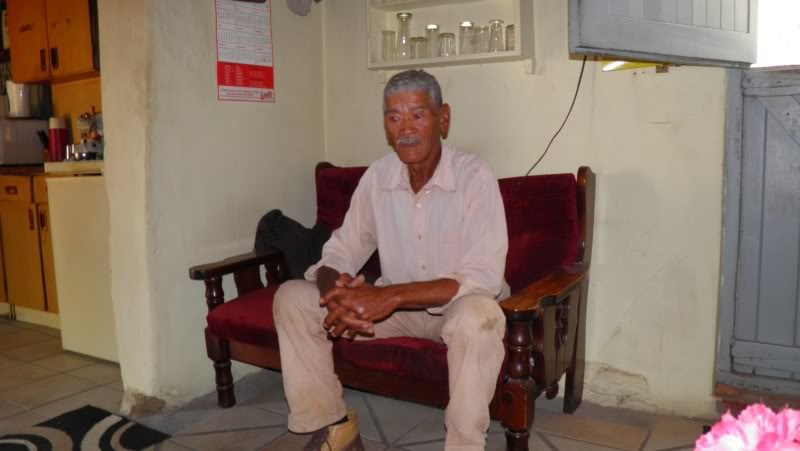
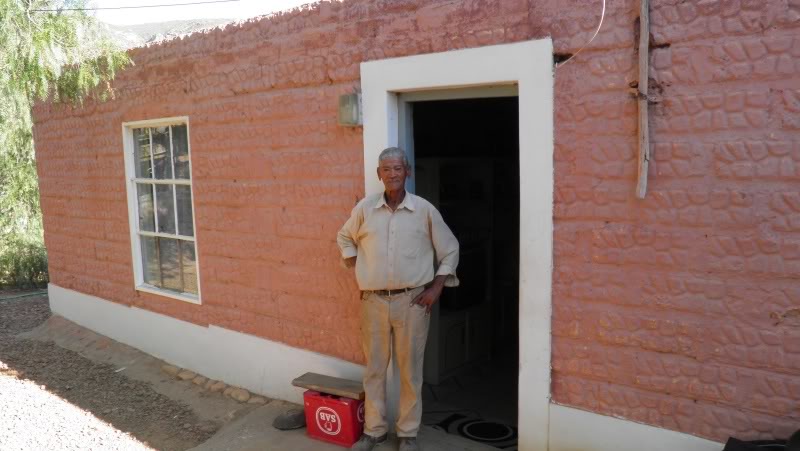
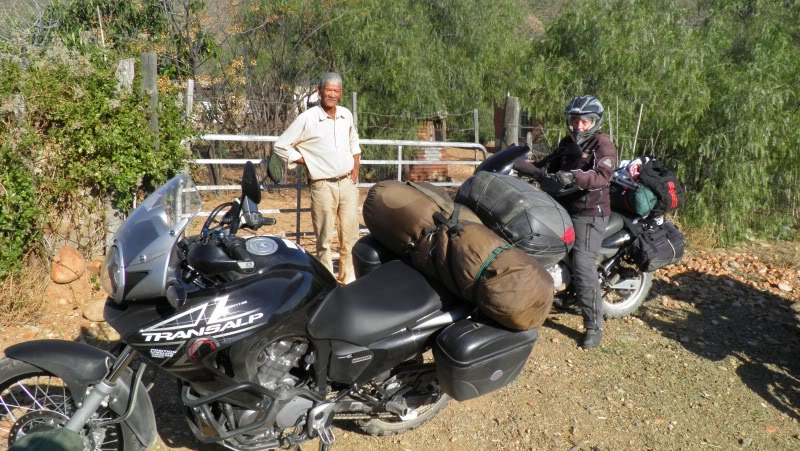
Nor was this the first time he had shared his account. Filmmaker Wendy Hardie had interviewed him earlier for her documentary Searching for Mermaids in the Karoo, broadcast on SABC in 2007. She identified him as Hermanus Fourie and recorded that, according to his recollection, he was eight when he first saw the Watermeid and twelve when he saw her again. Rock-art researcher Renée Rust had also spoken to him in 2005 and 2006.
Maans even offered to show us the place. Unfortunately, we had all arrived on motorcycles, and there wasn’t a spare seat for him. So we left that day without a photograph of his waterfall.
But I knew we had found something precious. Not a piece of proof or a sensation. A man willing to share with strangers something that meant a great deal to him.
A story older than Eporia
As I dug deeper into the research, I came upon a much older account.
In the nineteenth century, a man known as Afrikaander told D. Ballot of Molensrivier stories about women who lived in the water. One of the accounts was associated with Eseljagtspoort. These beings were described as powerful, dangerous inhabitants of the water, capable of seizing people and pulling them under.
The stories were recorded in the nineteenth century and later became part of scholarly research into the region. They did not, in other words, begin with the 1996 floods or a museum mannequin. Long before the modern name Eporia caught the public imagination, people were already telling stories about mysterious inhabitants of the Klein Karoo’s waters.
Even the word Watermeid carries more than one world within it. It calls to mind the European mermaid, but many of the stories I heard were less about a beautiful woman with a fish tail than about a powerful being associated with water. She may lure people, guard a pool, grow angry when her home is disturbed or move from one waterhole to another. And two people who grow up in the same region will not necessarily tell the same story.
That is part of the beauty of oral tradition. The story lives and changes with the people who tell it.
Why here, of all places?
My search eventually took me as far as Nieu-Bethesda. At the Owl House, among the strange and wonderful creations of Helen Martins and Koos Malgas, there are mermaid figures too. They need not have come from the same tradition as the Watermeid of the Klein Karoo, but here was another place where the image of a mermaid appeared in the most unexpected part of the interior.
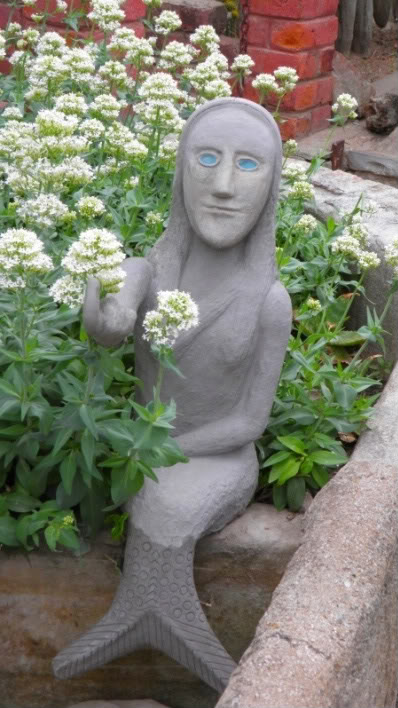
When I think back on the investigation today, it isn’t the museum mannequin or even the rock art that comes to mind first. It’s the people.
Katrina at Meiringspoort, who simply didn’t believe in mermaids. Jan beside the road and Samuel at his garden gate, for whom the stories were linked to people they had known and losses they had experienced. And Maans, who sat in his home and told us about the woman with the long black hair beside the waterfall.
Perhaps it is precisely in a dry country that water takes up so much room in people’s imaginations. A deep pool can sustain life, but it can be dangerous too. A river that runs peacefully for much of the year can tear away bridges and roads after a few days of rain. And around the places where water collects, stories take root and are handed from one generation to the next.
Some of these tales may certainly have served as warnings to children to stay away from deep water. But to dismiss the Watermeid as nothing more than a cautionary tale would be to miss much of what makes her interesting. There is fear and wonder in these stories, humour and sadness, memories of people who are no longer here and a particular relationship with the landscape.
The Watermeid lives in the stories, memories and imagination of the people of the Karoo. Whether anyone ever encounters her in a pool is no longer the most important question. Without her, those pools, rivers and mountain gorges would lose something of their meaning.
I set off on a motorcycle to look for a Watermeid. What I found was a region full of stories, waiting for someone to stop and listen.
Daar is stories oral om ons.