The Last Journey of Gideon Scheepers
From a Karoo farmhouse to a forgotten railway line and a grave that remains a mystery. Following the final trail of Gideon Scheepers through places you can still discover today.
PART TWO | THE LAST JOURNEY
From a Karoo farmhouse to a grave nobody can point out
Missed Part One?
Read On the Trail of Gideon Scheepers (Part One) →
When the commando had to ride on
The man who had evaded his pursuers across the Cape Colony for months could no longer stay in the saddle by October 1901.
Gideon Scheepers was seriously ill. His men transported him by wagon while British patrols continued to follow the commando’s trail. A wagon carrying a sick man was hardly ideal for a guerrilla force whose greatest advantage was speed.
At Koppieskraal, in the Prince Albert district, their paths separated. The young commander was left at the farmhouse and his men rode on. A British patrol subsequently found him there, in need of medical attention.
That was the end of Scheepers’ campaign, but not the end of his story. His trail now leads away from the battlefields, towards a farmhouse, a railway line, hospitals and, eventually, Graaff-Reinet.
Only remnants of the original Koppieskraal farmhouse survived in later years. A memorial recalls the place where his campaign came to an end. It is one of those historic sites you could easily pass without realising what happened there.
The turn-off at Bloedrivier
Driving along the N1 through the Karoo, you pass an old road sign: Bloedrivier. There is nothing about it to suggest that this turn-off belongs to one of the better-known stories of the Anglo-Boer War.
Yet this is where Scheepers’ final journey took a different turn. After his capture, he was brought to the railway at Bloedrivier on 12 October 1901 to travel by train to Matjiesfontein. The old station and the nearby railway tell the story of a time when this line was vital to the British war effort.
When I set out on the motorcycle to follow Scheepers’ trail, this was one of the places I wanted to investigate. A gravel road, a railway line, a handful of old buildings. Nothing out of the ordinary, you might think. Until you begin asking what happened here.
According to local history, Scheepers had to wait for his train at Bloedrivier and was taken to a nearby farmhouse to rest. The house stands on the farm Elim.
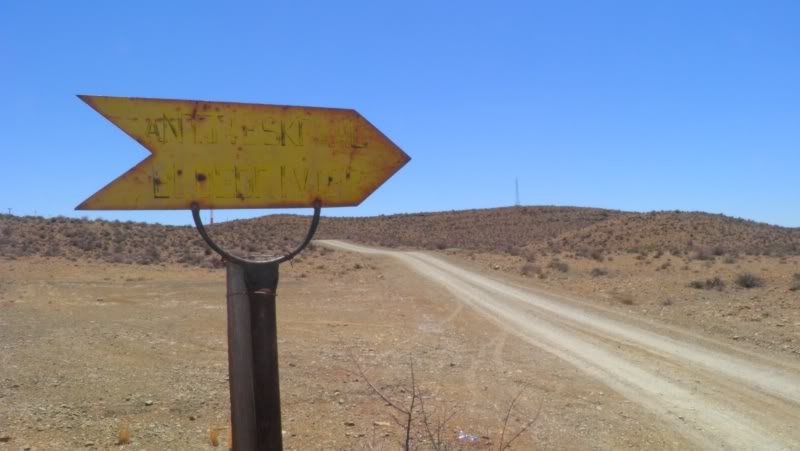
The Bloedrivier road sign. Just another turn-off from the main road, until you know the story behind the name.
The door that opened
I arrived at Elim without knowing exactly what I would find. And, as sometimes happens on a journey, my timing was not particularly good. It was just about lunchtime.
But the Botes family welcomed me warmly, invited me in and eventually even asked me to join them for lunch. They did not merely live in an old farmhouse. They had taken an interest in its history and preserved it. There were old photographs, documents and a scrapbook about Scheepers, along with copies of his diary.
Then they showed me the room that, according to the farm’s history, had been used when the sick commandant rested there.
Think about that for a moment. You turn down a gravel road, knock on a stranger’s door, and before long you are standing in a room that local memory has connected with an event from 1901 for generations. The house has changed over the years, but the story has endured.
Nor was it a tale invented for my visit. Local history accounts were already describing the Botes family, the farmhouse and Scheepers’ stay in the 1990s. What had looked like an ordinary farmstead from the road suddenly became a place with an extraordinary story.
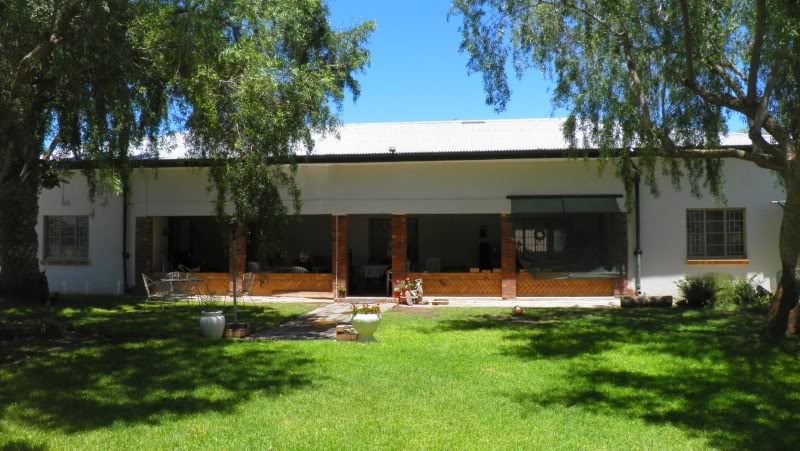
The old farmhouse at Elim near Antjieskraal. The Botes family preserved its history over many years.
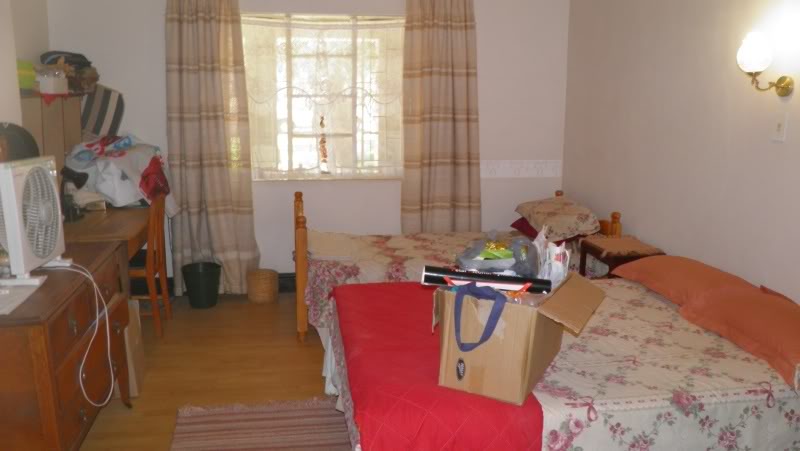
The room associated in local history with Scheepers’ brief stay. Sometimes a remarkable story lies behind an ordinary farmhouse door.
Blockhouses beside the railway
The railway at Bloedrivier has another story to tell. For much of the campaign, Scheepers and other Boer commandos tried to disrupt British rail communications. Trains carried soldiers, supplies and messages. Damage a bridge or a stretch of track, and the consequences could be felt far away.
The British responded with blockhouses: small, strong defensive structures beside bridges, railway lines and other important places. Some still stand in the Karoo, looking almost abandoned among the hills and dry riverbeds, even though they once guarded the lifelines of an army.
Not far from Elim there are remains of such structures in the Dwyka and Ketting areas. Looking around there, it was not hard to imagine the monotony of a soldier’s watch. A railway bridge, a long stretch of track and the same Karoo landscape, day after day.
Rudyard Kipling even captured the world of the Karoo railway guards in a poem. You do not have to know the story behind every old stone in this country to appreciate that these structures have stories to tell.
And there is an irony here. The very railway system that the commandos tried to damage now carried the sick Scheepers away under guard.
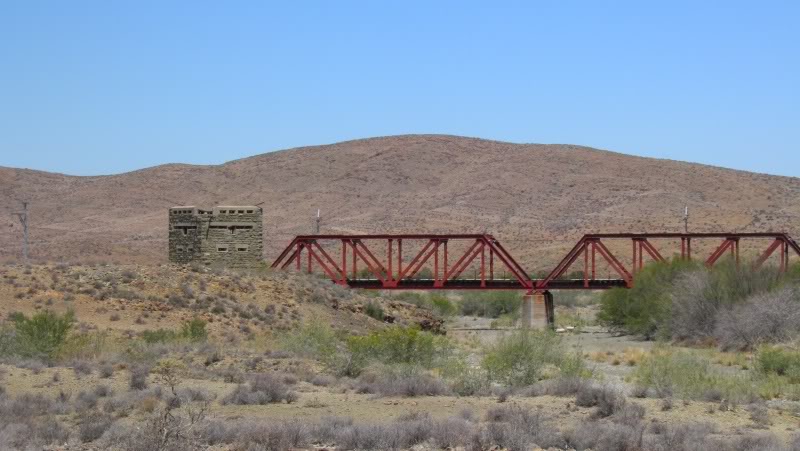
An old blockhouse near a railway bridge in the Karoo. Many of the structures built to protect the railway can still be recognised in the landscape.
The train to Graaff-Reinet
Scheepers was taken from Bloedrivier to Matjiesfontein. Further treatment followed at Beaufort West and Noupoort. From horse to wagon, from wagon to train, and from one hospital to another, his world was shrinking.
He reached Graaff-Reinet on 9 December 1901. This time he did not enter the town at the head of a commando. He arrived as a prisoner, and the British authorities decided to bring him before a military court operating under martial law.
The charges included murder, the mistreatment of prisoners and the destruction of property and railway infrastructure. Scheepers denied the murder allegations. He acknowledged ordering the destruction of certain property, which he maintained had been part of military operations.
Much has been written about the trial, its evidence and whether the proceedings were fair. It remains a complicated chapter of the war, with conflicting testimony and strongly held views. For the story of this journey, one fact matters most: the military court convicted Scheepers and sentenced him to death.
The sentence was publicly announced on 17 January 1902. The following day, he was taken outside Graaff-Reinet and executed by firing squad. He was 23 years old.
Photographs survive of both the public announcement and the execution. The Graaff-Reinet photographer Ivie H. Allan later described how he secretly took pictures of the execution. They are disturbing images, but they form part of the surviving record of Scheepers’ final days.
The grave nobody can point out
Scheepers was first buried near the place of his execution. His body was subsequently removed, and the location of his final resting place has never been established with certainty.
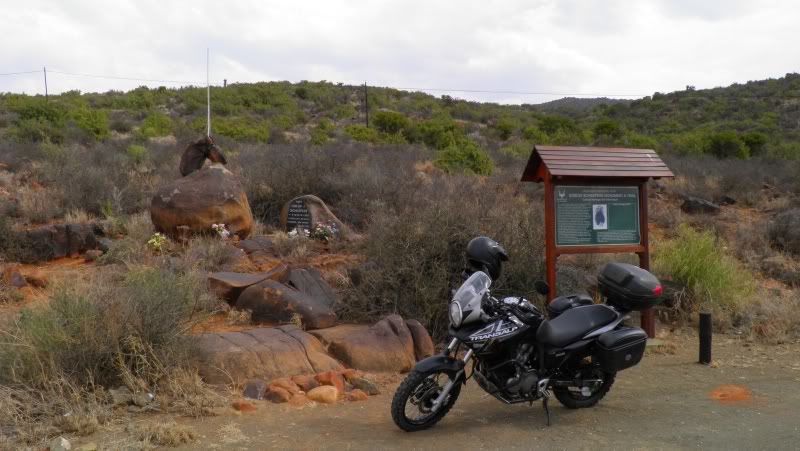
Outside Graaff-Reinet, along the Murraysburg road, there is a memorial made of large rocks and a sharp metal needle. It commemorates Scheepers near the presumed execution site. It is not his grave.
It is a curious ending for a man whose movements across the Cape Colony were followed so closely. There are accounts of where he fought, the farms where he stopped, the hospitals where he was treated, the court where he was tried, even photographs of his execution. Yet nobody can show you with certainty where he was finally buried.
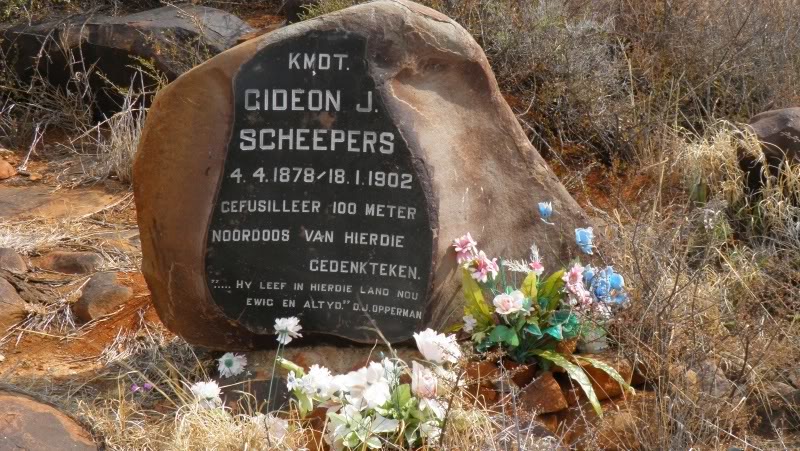
The memorial outside Graaff-Reinet commemorates Scheepers near the presumed site of his execution. It does not mark his grave.
The other places, however, are still there. The gravel road to Bloedrivier. The old railway blockhouses. The farmhouse where the Botes family kept part of the history alive. The memorial beside the road out of Graaff-Reinet.
You can get on a motorcycle or into a car and explore the country where these things happened. Some places are beside public roads; others are on private land, where permission is needed. But the journey begins with something much simpler than a map or a history book. Curiosity.
There are stories everywhere around us.
For the curious traveller
The Scheepers memorial stands outside Graaff-Reinet on the Murraysburg road. SANParks gives its position as 32°13′51.1″S, 24°31′04.8″E. The Bloedrivier turn-off from the N1 is another useful starting point for exploring this part of the story.
The farmhouses at Elim and Koppieskraal are not public museums. Arrange permission before entering private property, and stay clear of active railway lines and railway structures. Fortunately, you do not have to enter every site to appreciate the history of the surrounding landscape.
Continue reading: