Yamaha Ténéré 4 Concept: The Case for a Smaller Adventure Bike
Yamaha has revealed a new single-cylinder Ténéré concept that promises a lighter, more accessible approach to adventure riding. With proper off-road equipment and unmistakable Ténéré character, it could be exactly the sort of motorcycle many riders have been looking for. But it isn't ready for the showroom just yet.
Adventure motorcycles have become increasingly impressive over the past decade.
More power, bigger engines, sophisticated suspension and enough electronic equipment to keep an aircraft technician entertained.
And yet, somewhere along the way, the simple idea of a relatively light motorcycle that can comfortably explore a gravel road started to look rather appealing again.
Yamaha appears to have been listening.
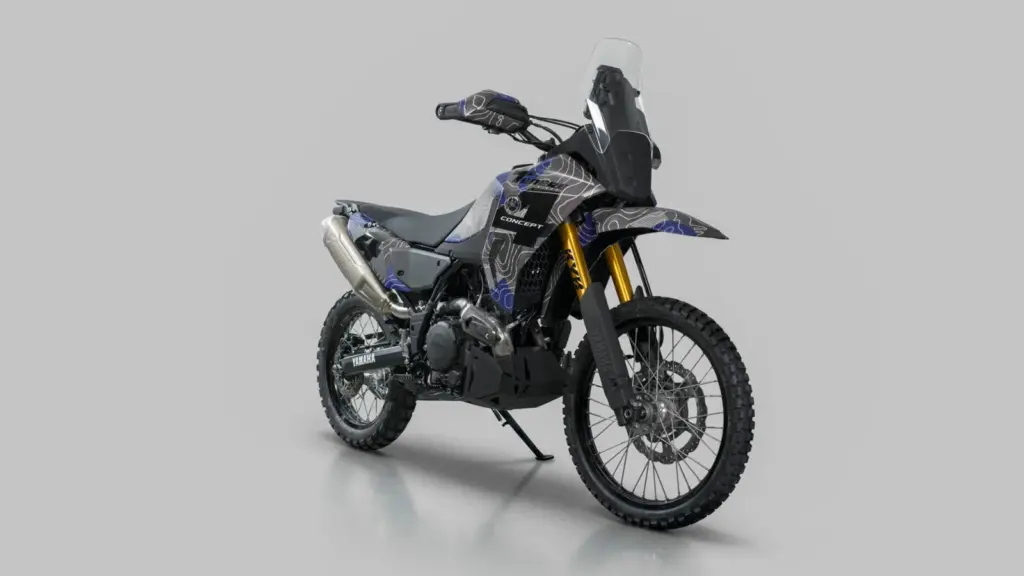
At its Redefine the Standard presentation in Milan on 2 November 2026, ahead of the EICMA motorcycle show, Yamaha unveiled the Ténéré 4 Concept.
It is a smaller adventure motorcycle powered by a completely new single-cylinder engine, with a chassis designed around reduced weight, agility and genuine off-road ability.
Importantly, Yamaha describes the motorcycle as an ongoing development project.
It is not yet a confirmed production model, and there is no official launch date or price.
Nevertheless, the Ténéré 4 could become one of the more significant additions to Yamaha's adventure range in years.
Back to the original idea
The Ténéré name carries a considerable amount of history, particularly for riders who remember Yamaha's early Paris-Dakar motorcycles.
Yamaha's XT500 helped establish that reputation by winning the inaugural Paris-Dakar Rally in 1979.
The original XT600 Ténéré, presented in 1982, developed the idea of a motorcycle capable of long-distance travel and challenging terrain without the bulk of today's biggest adventure machines.
The modern Ténéré 700 has continued that philosophy with its well-regarded 689 cc parallel-twin engine and strong off-road credentials.
But even a capable middleweight adventure motorcycle can become something of a handful when loaded with luggage or manoeuvred through particularly difficult terrain.
That is where a smaller Ténéré could make considerable sense.
Yamaha says the new concept was developed partly in response to customer demand for a more accessible adventure motorcycle.
It is intended for riders entering the adventure category as well as experienced motorcyclists looking for something lighter.
An entirely new single-cylinder engine
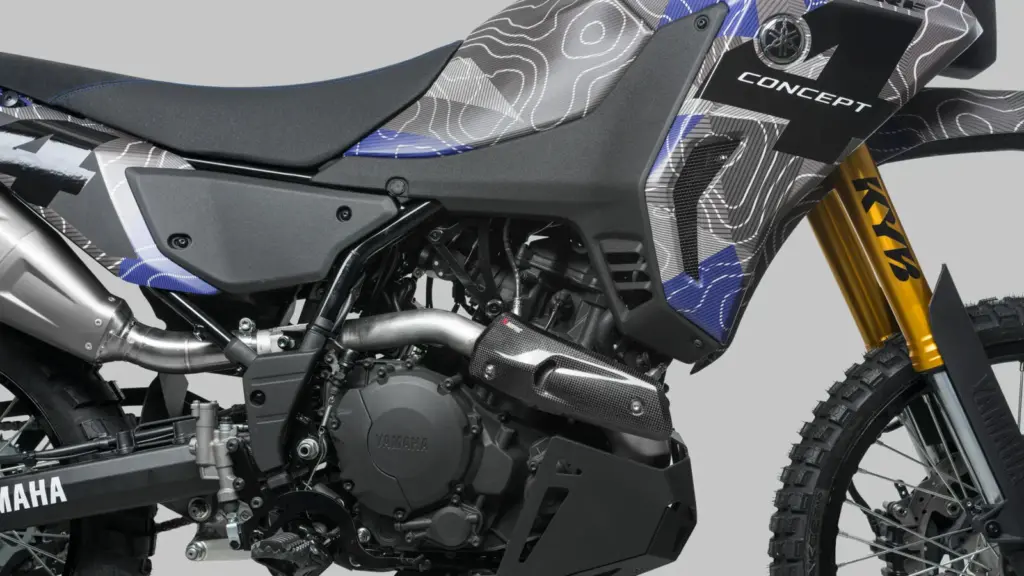
One of the most interesting parts of the Ténéré 4 is its engine.
Rather than adapting the Ténéré 700's parallel twin, Yamaha has developed a new single-cylinder powerplant.
The manufacturer says the engine is intended to provide strong torque at low and medium engine speeds while remaining responsive higher in the rev range.
That is an encouraging objective for an adventure motorcycle.
On loose gravel, rocky climbs and narrow tracks, predictable low-speed power delivery is often more valuable than outright horsepower.
A single-cylinder engine can also offer advantages in packaging and mechanical simplicity, although the final weight and complexity of Yamaha's design remain unknown.
The Ténéré 4 has been developed with Europe's A2 motorcycle licence category in mind.
That suggests Yamaha wants an approachable performance package, but it does not establish a particular engine capacity.
Although the number four in the model name has encouraged speculation about a 400 cc motorcycle, Yamaha has not confirmed displacement.
Neither has it released a maximum power or torque figure.
Until those numbers are published, comparisons based on assumed engine specifications would be premature.
Designed for the dirt
While engine details remain limited, the chassis specification tells us considerably more about Yamaha's intentions.
The Ténéré 4 Concept features an entirely new frame designed to balance structural strength with low weight.
Suspension components are supplied by KYB.
Yamaha has not yet released suspension travel figures or confirmed the full range of adjustment.
More revealing is the wheel combination.
The concept uses a 21-inch spoked front wheel and an 18-inch spoked rear wheel.
These are traditional off-road-oriented sizes, particularly suited to negotiating obstacles and difficult surfaces.
The motorcycle displayed at EICMA is fitted with Michelin Anakee Wild tyres, further underlining its intended character.
A compact titanium Akrapovič exhaust completes the show motorcycle's specification.
Whether that exhaust, along with the other premium components, will appear on an eventual production motorcycle remains to be seen.
Built for standing on the footpegs
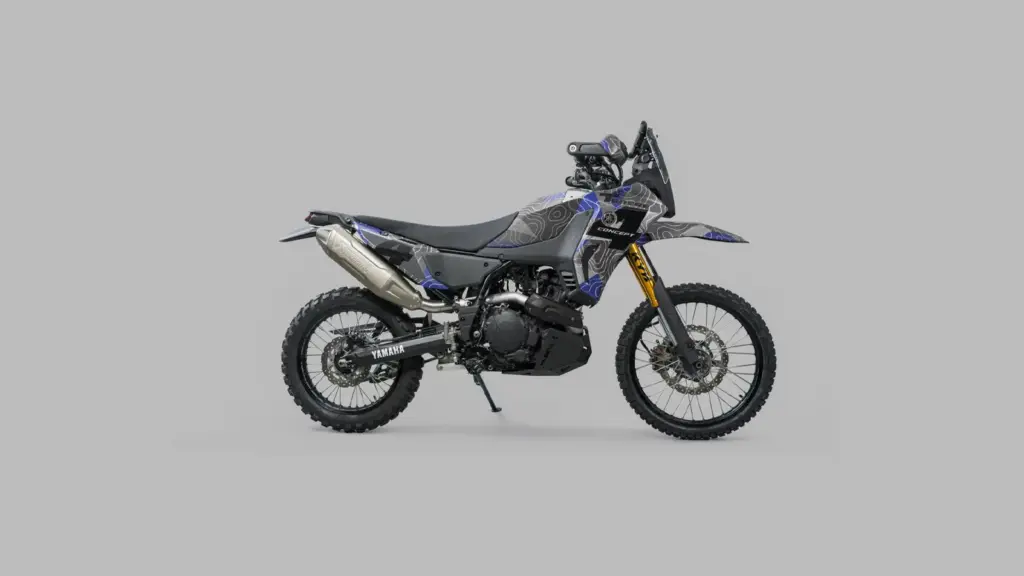
The Ténéré 4 is immediately recognisable as a member of Yamaha's adventure family.
There is a tall, rally-inspired front end, a narrow body and a relatively flat seat arrangement.
The fuel tank has a low-profile design, while the bodywork features distinctive topographical graphics inspired by the landscapes adventure riders enjoy exploring.
The emphasis is clearly on allowing the rider to move around the motorcycle.
That is important when riding off-road, where standing on the footpegs and shifting body weight can make an enormous difference to control.
Yamaha says the concept's ergonomics were developed using experience gained from the Ténéré 700.
However, physical dimensions and seat height have not yet been announced.
A motorcycle can look compact in photographs and still have a challenging seat height.
This will be one of the important measurements to examine when Yamaha releases a production specification.
Why South Africa should pay attention
South Africa is particularly well suited to smaller adventure motorcycles.
There are thousands of kilometres of gravel roads, mountain passes and remote routes that can be enjoyed without needing a massive engine.
The Garden Route, Klein Karoo and wider Southern Cape are excellent examples.
A rider can spend an entire day exploring interesting roads without travelling particularly fast.
In those conditions, confidence, manageable weight and suspension performance often matter more than maximum power.
Smaller motorcycles can also make it easier to explore less familiar routes, particularly for riders travelling alone.
But there must still be enough performance to handle the long stretches of tar that connect South Africa's interesting places.
That balance between off-road manageability and real-world touring ability will be crucial to the Ténéré 4's success.
Some serious competition
If Yamaha takes the Ténéré 4 into production, it will enter a market that has already become highly competitive.
The CFMOTO 450MT has attracted considerable attention with its 449 cc parallel-twin engine and genuine off-road equipment.
Royal Enfield's Himalayan 450 combines a modern single-cylinder engine with a straightforward approach to adventure riding.
The KTM 390 Adventure R offers a more performance-focused interpretation of the smaller adventure motorcycle, with serious suspension and off-road geometry.
These motorcycles have already demonstrated that buyers are interested in capable adventure machines that are smaller and more approachable than traditional large-capacity adventure tourers.
A production Ténéré 4 could give Yamaha an important presence in that category.
But the Yamaha badge alone will not guarantee success.
It will need a competitive price, useful equipment and a convincing combination of quality and riding ability.
Much will also depend on how closely any production motorcycle resembles the concept unveiled in Milan.
The questions Yamaha still needs to answer
There are several important details still missing from Yamaha's announcement.
Engine capacity, maximum power, torque, fuel capacity and ready-to-ride weight are all unconfirmed.
The seat height, suspension travel, electronics and final braking specification also remain to be announced.
Perhaps most importantly, Yamaha has not confirmed when a production Ténéré 4 might become available.
Nor has it announced a South African launch, local specifications or an expected selling price.
These are not minor details.
A motorcycle designed to feel lighter and more accessible must actually deliver on those objectives when measured and ridden.
Equally, a smaller adventure motorcycle loses some of its appeal if it ends up costing almost as much as a larger, more powerful alternative.
Yamaha has a promising concept, but the final production decisions will determine whether it becomes a particularly compelling motorcycle.
Perhaps smaller really is better
The Ténéré 4 Concept represents an encouraging direction for adventure motorcycling.
Rather than introducing another enormous machine with increasingly impressive power figures, Yamaha is exploring a different approach.
A motorcycle designed to be lighter, more manageable and easier to enjoy when the road becomes difficult.
That doesn't mean larger adventure motorcycles are suddenly unnecessary.
They remain excellent tools for carrying passengers, luggage and covering long distances.
But not every adventure requires a large motorcycle.
Sometimes the most enjoyable ride begins when the road becomes too narrow, too rough or too interesting for something heavier.
The Ténéré 4 could become a particularly attractive option for exactly that sort of riding.
For now, it remains a concept with plenty of unanswered questions.
But if Yamaha can turn the idea into a sensibly priced, genuinely capable production motorcycle, the smaller adventure class could become even more interesting.
And for riders who believe that the best road is often the one that isn't tarred, that is a welcome possibility.
SHARE THIS ARTICLE
Enjoyed the ride? Share the story.