Honda V3R 900 E-Compressor: Three Cylinders, a Very Different Future
A 900 cc V3 engine with an electrically powered compressor, promising the performance of a much larger motorcycle. Honda's extraordinary V3R 900 is moving closer to production, and it could introduce an entirely different approach to motorcycle performance.
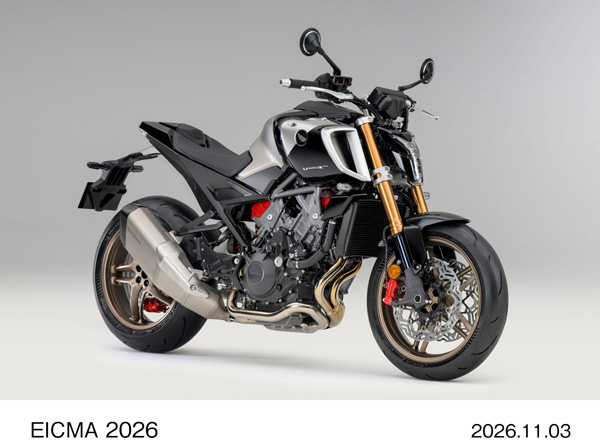
Motorcycle manufacturers have spent decades trying to achieve a familiar objective: more performance from smaller, lighter and increasingly efficient engines.
The solutions have included bigger engines, higher rev limits, sophisticated electronics and increasingly complicated valve systems.
Honda has decided to try something rather different.
Its V3R 900 E-Compressor uses an unusual three-cylinder V engine combined with an electrically powered, electronically controlled compressor to deliver additional performance when required.
The basic idea is to produce the performance characteristics of a larger engine without necessarily having to build a larger engine.
It is a fascinating approach, particularly at a time when motorcycle manufacturers face increasingly demanding emissions and efficiency requirements.
At EICMA 2026, Honda presented its latest version of the V3R 900, now officially described as a planned-production model.
And although plenty of questions remain unanswered, the motorcycle is considerably closer to something riders might eventually find in a showroom.
Three EICMA shows, one unusual idea
The V3 story began at EICMA 2024, when Honda unveiled a new three-cylinder engine with an electrically powered compressor.
At that stage, there was no complete motorcycle. Honda was demonstrating an engineering concept rather than announcing a new model for sale.
The following year, the company presented the V3R 900 E-Compressor Prototype, a complete motorcycle wrapped in distinctive red-and-black geometric camouflage.
It looked unlike anything else in Honda's contemporary range.
The asymmetrical bodywork, exposed engine and aggressive naked-bike proportions made it clear that Honda wasn't developing an ordinary middleweight roadster.
Now, at EICMA 2026, the camouflage has disappeared.
The latest motorcycle has more refined styling, road-going equipment and a number of new features that suggest Honda is preparing it for production.
Importantly, Honda calls this a planned-production model, not a motorcycle already available to order.
Why a V3?
Three-cylinder motorcycle engines are nothing new. Triumph, Yamaha and other manufacturers have demonstrated the appeal of their distinctive power delivery.
But those motorcycles generally use inline three-cylinder engines.
Honda's design is different.
Its three cylinders are arranged in a 75-degree V configuration, creating a particularly compact engine package.
The liquid-cooled unit has a displacement of 900 cc.
A compact engine allows engineers more freedom when positioning components within the motorcycle.
That can have advantages for packaging, overall dimensions and weight distribution.
However, it is the compressor that makes Honda's engine especially interesting.
What exactly is an E-Compressor?
To understand the idea, it helps to look at how an engine produces power.
A conventional naturally aspirated engine draws air into its cylinders as the pistons move.
Compressing additional air into the intake allows the engine to burn more fuel under suitable conditions and produce more power.
This is the principle behind forced induction.
A conventional turbocharger uses exhaust gas to drive a turbine, which in turn drives a compressor.
A traditional mechanically driven supercharger takes its drive from the engine.
Honda's approach uses an electrically powered compressor with electronic control over the intake-air compression.
The important advantage is that compressor operation need not be directly tied to engine speed.
Honda says this allows additional torque to be delivered with a quick response, even at relatively low engine speeds.
That could be particularly useful for a road motorcycle, where the rider needs strong acceleration when overtaking or leaving a corner, rather than only at very high revs.
Honda also says the compressor arrangement does not require a separate intercooler, helping with packaging in the limited space available on a motorcycle.
The system does, of course, introduce additional components and electrical demands. How those are managed will be important when the final production motorcycle is assessed.
900 cc performance with a 1 200 cc ambition
Honda has made an interesting claim about what it expects from the V3R 900.
The company says its objective is to achieve performance comparable with a 1 200 cc engine, despite the V3 having a displacement of only 900 cc.
That does not mean every 1 200 cc motorcycle produces the same performance, nor does it establish a specific power or torque figure.
Different engines have very different characteristics.
What Honda appears to be targeting is the strong, accessible torque associated with larger-capacity motorcycles, combined with the compactness of a smaller engine.
As of November 2026, Honda has not published final maximum power or torque figures for the V3R 900.
Neither has it released a complete production specification.
It will be fascinating to see whether the motorcycle eventually delivers the smooth, immediate response Honda is promising.
The camouflage comes off
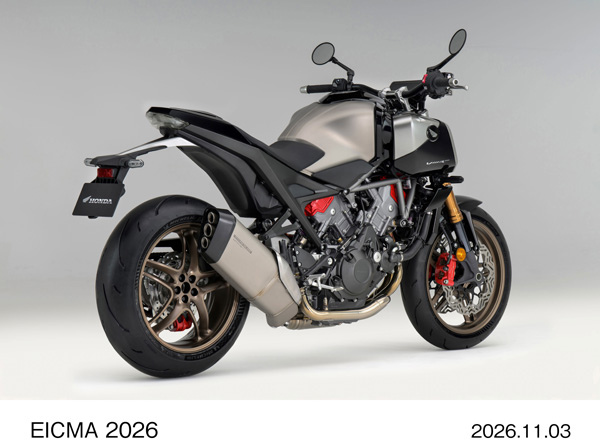
The V3R 900 has retained much of the unusual character of the earlier prototype.
Its exposed engine, muscular proportions and asymmetrical side panels are immediately distinctive.
Rather than trying to disguise the unconventional engine, Honda has made it a central part of the design.
There are also some rather special materials involved.
Honda says the planned-production model incorporates a titanium fuel tank, titanium exhaust pipes and a titanium muffler.
Titanium offers an attractive combination of strength, corrosion resistance and relatively low weight.
It is also an expensive material, more commonly associated with specialised performance components than ordinary production motorcycles.
Its use suggests that Honda is positioning the V3R as something rather special.
Whether every titanium component will remain on the final showroom version is something that will need confirmation.
Technology beyond the engine
The E-Compressor may attract most of the attention, but Honda has also revealed improvements to the motorcycle's connected technology.
The V3R incorporates an enhanced version of Honda RoadSync, the manufacturer's smartphone connectivity platform.
Honda says the updated system includes improvements to its human-machine interface, making functions easier to access and use.
It also introduces AI-assisted voice control technology.
That could be particularly useful on a motorcycle, where operating complicated menus while riding is neither convenient nor desirable.
The effectiveness of the system will depend on how reliably it works with riding equipment, wind noise and everyday conditions.
Honda has not yet confirmed the complete functionality or market-specific availability of these features.
Where would it fit in the market?
Judging by its design and engine concept, the V3R 900 is being developed as a performance-oriented naked motorcycle.
That places it in a broad part of the market occupied by motorcycles such as the Yamaha MT-09, Triumph Street Triple and KTM 990 Duke.
Those motorcycles approach performance in different ways, and the Honda's eventual price and final specification will determine its closest rivals.
There is also an interesting technical comparison with Kawasaki's supercharged Z H2.
Kawasaki uses forced induction with a mechanically driven supercharger, while Honda is pursuing its electrically powered compressor arrangement.
The two motorcycles cannot yet be compared meaningfully on performance because Honda has not published its final figures.
Nevertheless, the difference in engineering approach makes the V3R particularly interesting.
What about South Africa?
Honda has confirmed that the V3R 900 E-Compressor is being developed for production.
However, a confirmed production timetable has not yet been announced.
Neither has Honda confirmed South African availability, local pricing or a launch date for our market.
Until those details become available, it is impossible to establish where the V3R would sit in terms of local value.
Its sophisticated engine, unusual layout and titanium components also raise interesting questions about production costs and long-term servicing.
These are not necessarily problems, but they are factors that potential buyers will want to understand.
For now, the V3R 900 is best viewed as an intriguing upcoming motorcycle, rather than a confirmed South African showroom introduction.
Honda doing what Honda does best
The motorcycle industry often seems to move in cycles.
Manufacturers follow successful trends, develop competing models and gradually refine familiar ideas.
Occasionally, somebody decides to try an entirely different approach.
Honda has a long history of unconventional motorcycle engineering, and the V3R 900 E-Compressor appears to continue that tradition.
Its greatest achievement may not ultimately be a particular power figure or top speed.
It could be demonstrating that internal combustion motorcycle engines still have room for meaningful innovation.
Whether the electronically controlled compressor becomes a major new direction for the industry will depend on what happens when the motorcycle reaches production.
It must deliver the promised performance, remain practical to own and justify its complexity.
Until then, the V3R 900 is one of the most fascinating motorcycles at EICMA 2026.
Not because it is the most powerful, but because it asks a rather interesting question:
What if the future of motorcycle performance isn't simply about building a bigger engine?
SHARE THIS ARTICLE
Enjoyed the ride? Share the story.