Royal Enfield Himalayan 750: Bigger Engine, Different Mission
Royal Enfield has finally revealed its twin-cylinder Himalayan. With more power, greater touring capability and a comprehensive electronics package, the 750 takes the Himalayan name into new territory. But it is not simply a bigger version of the 450.
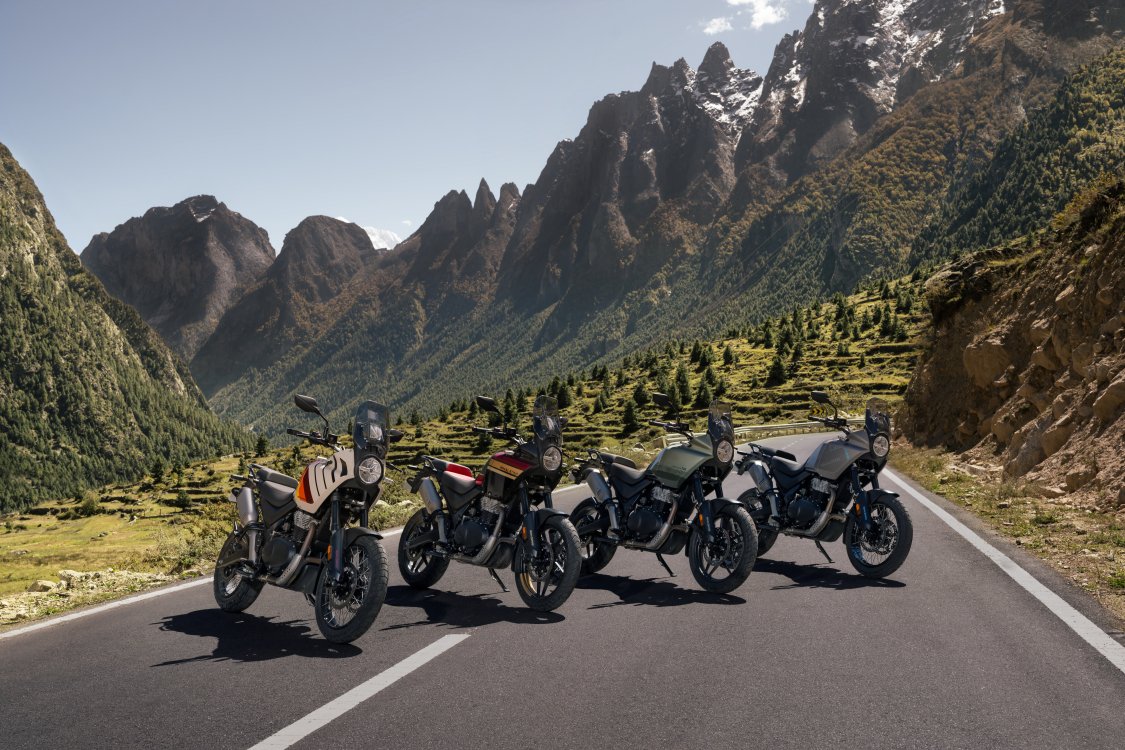
When Royal Enfield introduced the original Himalayan in 2016, it offered something rather refreshing in a motorcycle market increasingly obsessed with horsepower, electronics and ever-bigger adventure machines.
It was relatively simple, approachable and designed around the idea that you didn't need a particularly expensive motorcycle to go exploring.
The Himalayan 450 took that philosophy considerably further, introducing a modern liquid-cooled engine, better suspension and improved performance while retaining the motorcycle's accessible character.
Now Royal Enfield has taken another step.
Revealed at EICMA 2026 in Milan, the Himalayan 750 introduces an entirely new 743 cc parallel-twin engine and a broader range of touring equipment.
On paper, it is the most substantial Himalayan yet. But the interesting question is not whether it is more powerful than the 450.
It is whether Royal Enfield has managed to create a genuinely useful middleweight adventure tourer without losing the qualities that made the Himalayan appealing in the first place.
A new 743 cc parallel twin
At the heart of the Himalayan 750 is Royal Enfield's new air- and oil-cooled 743 cc parallel-twin engine.
It produces a claimed 40.5 kW at 7 000 r/min and 63 Nm at 5 000 r/min, driving through a six-speed gearbox.
Those figures are hardly going to frighten the superbike manufacturers, but that is rather missing the point.
Royal Enfield has traditionally placed greater emphasis on accessible, usable performance than chasing impressive peak-power figures.
The company says that 90% of the Himalayan 750's maximum torque is available from just 3 500 r/min.
That suggests an engine intended to deliver its performance without constantly needing to be worked hard through the gears.
For a motorcycle designed to cover long distances with luggage and potentially a passenger, that approach makes considerable sense.
The real test will be how smoothly it delivers that torque, particularly at low speeds on uneven surfaces and when overtaking on the open road.
More touring, less trail?

One of the most revealing details is the Himalayan 750's wheel configuration.
Where the Himalayan 450 uses a 21-inch front wheel, the new 750 has a 19-inch front and 17-inch rear combination.
That points towards a motorcycle intended to offer a more road-biased balance between stability, handling and gravel-road capability.
A 21-inch front wheel generally provides an advantage over larger obstacles, deep ruts and rougher off-road terrain.
A 19-inch front wheel is a common compromise on adventure tourers, offering a useful balance for riders who spend more time travelling than tackling difficult trails.
Royal Enfield will offer the Himalayan 750 with either cast-alloy wheels or tubeless spoked wheels, depending on the specification.
This is an important distinction: the 750 has not necessarily been designed to replace the 450. It appears to have been developed for a somewhat different type of adventure riding.
Suspension and chassis
The Himalayan 750 uses a steel box-section spine frame, with the engine forming a stressed part of the structure.
Suspension is supplied by Showa, with 43 mm upside-down forks offering adjustable preload, compression and rebound damping.
Front suspension travel is 190 mm, while the rear monoshock provides 175 mm of travel.
The rear shock features adjustable rebound damping and a remote spring-preload adjuster, a particularly useful feature when switching between solo riding and travelling with luggage.
Braking duties are handled by twin 280 mm front discs and a single 255 mm rear disc.
Ground clearance is 205 mm, and the standard seat height is a relatively approachable 815 mm.
The fuel tank holds 17.8 litres, and Royal Enfield quotes a kerb weight of 224 kg with 90% fuel and oil.
That weight figure is worth remembering.
The Himalayan 450 is officially listed at 196 kg, making the 750 approximately 28 kg heavier.
More power and additional touring equipment bring advantages, but extra weight is rarely an advantage when a motorcycle needs to be picked up on a rocky trail.
Again, the specification suggests that Royal Enfield has deliberately given the larger Himalayan a different role.
Technology without abandoning simplicity
The Himalayan 750 is also a considerable step forward in terms of electronics.
There are five riding modes, a six-axis inertial measurement unit, cornering ABS and lean-sensitive traction control.
The rear ABS can be switched off for off-road riding, while the traction control offers selectable levels of intervention.
Cruise control is included, along with a tyre-pressure monitoring system.
A circular four-inch TFT instrument display incorporates navigation functionality and smartphone connectivity.
There is also a manually adjustable windscreen, separate rider and pillion seats, updated LED lighting and USB charging.
These are features that long-distance riders will appreciate, particularly when travelling for several days at a time.
The challenge for Royal Enfield will be ensuring that the additional technology remains intuitive and doesn't complicate what has traditionally been a straightforward motorcycle.
Himalayan 450 or Himalayan 750?
This is probably the most interesting question for existing Himalayan owners.
The 450 uses a liquid-cooled 452 cc single-cylinder engine, producing approximately 29.4 kW and 40 Nm.
It also has a 21-inch front wheel, greater ground clearance and a substantially lower kerb weight.
Those characteristics make it particularly appealing to riders who enjoy exploring smaller gravel roads and more demanding terrain.
The 750, by comparison, offers considerably more torque, twin-cylinder performance, additional touring equipment and a more road-oriented wheel combination.
For the rider who regularly covers long highway distances, carries luggage and wants to explore gravel roads along the way, the 750 may prove the more comfortable choice.
For someone who prioritises lower weight, more challenging off-road routes and maximum manoeuvrability, the 450 could remain the better tool.
Bigger is not automatically better. It depends entirely on where and how the motorcycle will be used.
Where does it fit in South Africa?
The middleweight adventure market has become one of the most interesting parts of the motorcycle industry.
South African buyers can already choose from a wide variety of adventure motorcycles, including machines such as the Yamaha Ténéré 700, Honda XL750 Transalp and Suzuki V-Strom 800.
These motorcycles differ considerably in engine performance, suspension, electronics and intended use.
The Himalayan 750 appears to approach this market from a more traditional, accessible direction.
It is not trying to compete simply by producing the highest power output or offering the most extreme off-road specification.
Instead, Royal Enfield seems to be concentrating on usable torque, touring practicality and manageable dimensions.
That could be an appealing combination for local riders who want to tour the Garden Route, cross the Klein Karoo or explore the country's extensive gravel-road network.
Whether the Himalayan 750 represents good value will depend heavily on its South African selling price.
What will it cost?
International prices have been announced, with the Himalayan 750 starting at £6,999 in the United Kingdom.
However, overseas pricing cannot simply be converted into rand to establish a realistic local price.
Import costs, taxes, market specifications and distribution arrangements all influence what South African buyers eventually pay.
As of November 2026, Royal Enfield has not confirmed South African pricing or an official local arrival date for the Himalayan 750.
Until those details become available, any claim that it will undercut a particular competitor would be premature.
A different kind of Himalayan
The Himalayan 750 represents an important development for Royal Enfield.
Ten years after introducing the original Himalayan 411, the company now has a much broader idea of what adventure riding can involve.
The Himalayan 450 remains an attractive option for riders who value simplicity, manageable weight and more demanding gravel riding.
The new 750 adds another possibility: longer journeys, greater touring comfort, stronger performance and more equipment.
Its 224 kg weight and 19-inch front wheel suggest that it will not necessarily be the better choice for difficult trails.
But it could be a very appealing motorcycle for the rider whose idea of adventure involves travelling a long way, carrying what is needed and taking the interesting road whenever possible.
The final verdict will depend on how it rides, how comfortable it proves over distance and, perhaps most importantly, what it costs in South Africa.
Until then, the Himalayan 750 is certainly one of EICMA 2026's more interesting adventure motorcycle introductions.
SHARE THIS ARTICLE
Enjoyed the ride? Share the story.